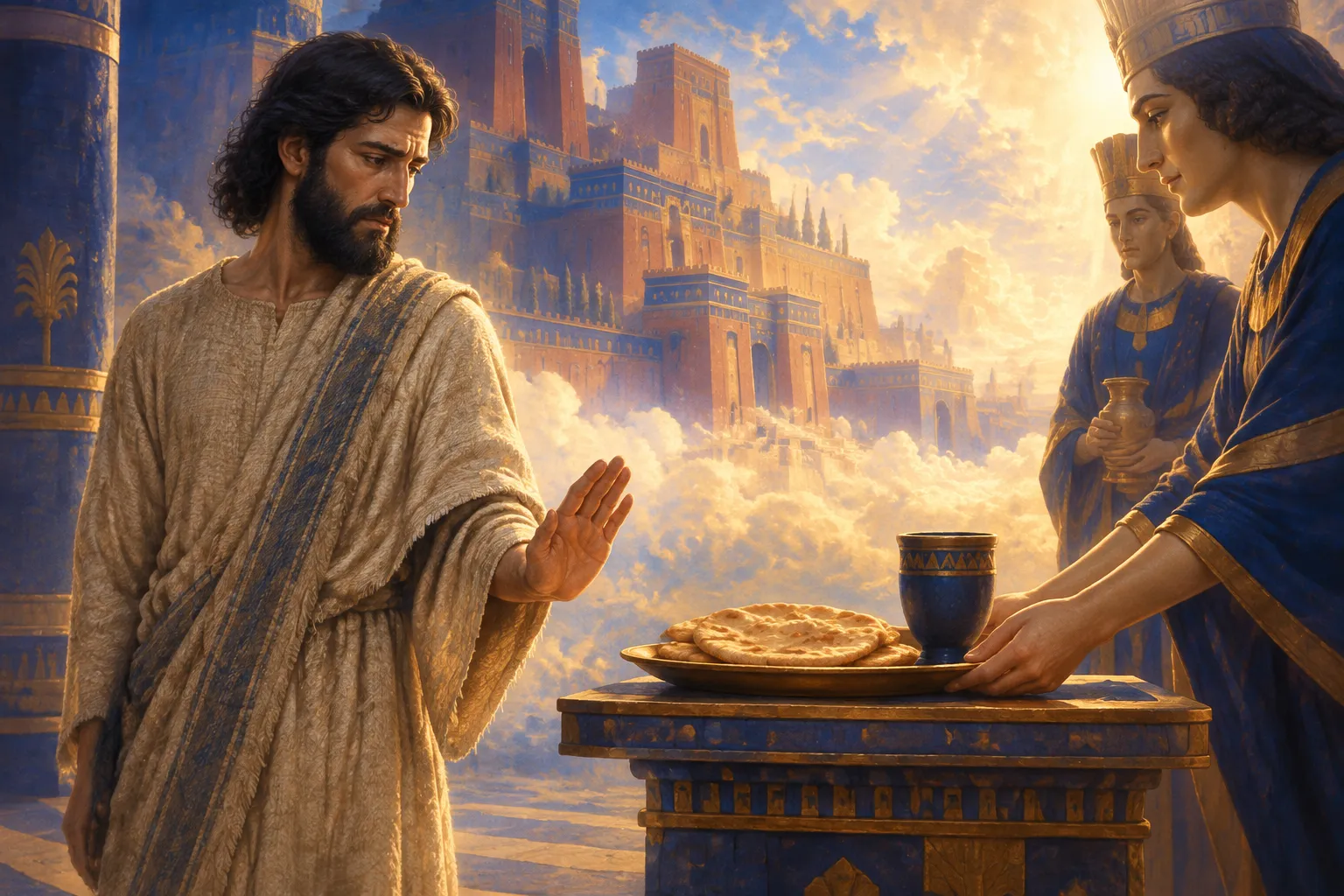
The food is offered, but Adapa will not eat. Water follows, and he refuses that too. Before the heavenly god Anu, the sage follows instructions from his own divine master, Ea. The difficulty is that Ea warned him about deadly provisions, while the narrator identifies the offerings as life-giving. The university-hosted account of Adapa’s audience preserves this unsettling reversal: doing precisely what a god commands may mean declining something extraordinary.
Was Adapa cheated out of immortality? That is a compelling reading, but it is not the only one. The narrow question of why he refuses has a straightforward answer: obedience. What that obedience accomplishes is harder to settle. Keeping those questions separate reveals a more interesting Babylonian story than a simple fable about a foolish missed opportunity.
A Babylonian story with several surviving witnesses
The discussion here concerns the Akkadian-language Adapa tradition, centered on the sage of Eridu in southern Mesopotamia. Its surviving witnesses must not be flattened into one timeless original. In his 1981 study, Niels-Erik Andreasen identifies the important Amarna fragment B with the fourteenth century BCE and fragments A, C, and D with Ashurbanipal’s seventh-century BCE library. His discussion of the textual witnesses distinguishes an Egyptian findspot from the later Assyrian preservation of the narrative.
Those distinctions matter when a translation reads like a continuous short story. A smooth modern account can make separated pieces seem more seamless than their transmission warrants. A manuscript’s date and location tell us where that particular witness belongs; they do not automatically date every episode in the story.
Names also deserve care. Ea is the name used here for Adapa’s divine master; Andreasen identifies his Sumerian counterpart as Enki. That relationship does not make an Akkadian narrative a Sumerian text. Likewise, an Assyrian library could preserve Babylonian literary material without turning every feature of its imagined world into a specifically Assyrian institution.
Before heaven, a working life in Eridu
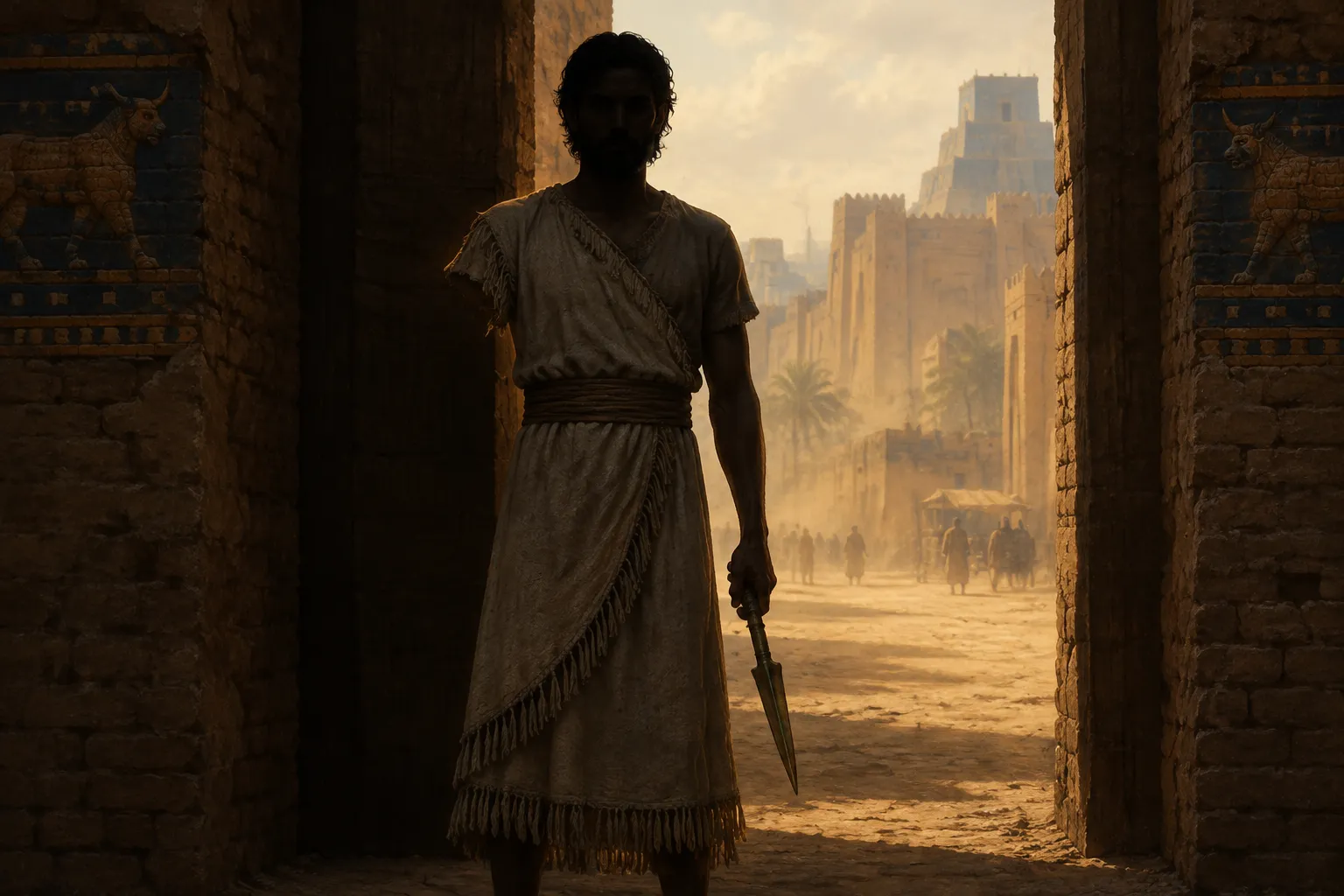
Adapa’s first setting is not a quest for everlasting life. It is work. The early translation preserved by Columbia University describes him baking, preparing provisions and a table, steering a boat, and supplying fish. Then the South Wind plunges him into the water. Adapa threatens its wing, and his speech immediately disables it; the wind remains absent for seven days. These concrete details appear together on the translated page from the 1901 collection.
Read closely, this is an arresting introduction to a sage. Knowledge appears through skilled service rather than through an abstract lecture. The movement from a prepared table to a fishing boat also gives the later heavenly meal an ironic shape: a man associated with providing food becomes the guest who will not consume it.
His response to the wind creates a second reversal. At sea, his words are devastatingly effective; in heaven, his decision depends on words supplied by someone else. My reading is that the contrast makes his predicament sharper. Adapa is neither simply powerless nor safely self-sufficient. His exceptional ability can create a problem that exceptional ability alone cannot resolve.
The Columbia translation is useful as an accessible historical rendering, not as the last word on damaged Akkadian passages. Its question marks and gaps are reminders that uncertainty belongs in the reading rather than being silently repaired.
Ea’s instructions: how to survive an audience
Before Adapa reaches Anu, Ea prepares him. He must wear mourning clothes and win the goodwill of the divine gatekeepers, Tammuz and Gizzida. He must refuse the food and water presented to him, but accept clothing and anointing oil. The sequence of instructions and their fulfillment makes the distinction explicit: Ea does not order a blanket rejection of heavenly hospitality.
That selectiveness is important. Adapa’s refusal is not presented as a spontaneous dislike of the food or a general refusal to recognize his host. He follows a carefully differentiated plan. A garment and oil are acceptable; eating and drinking are not.
One way to read the scene is as a problem of information. Adapa has to decide how to behave in circumstances where he cannot independently verify the most important thing: what the offered meal will do to him. Trust in Ea supplies the missing knowledge, or seems to. The audience can perceive a discrepancy between warning and offering that the obedient guest does not resolve for himself.
This makes the scene uncomfortable without requiring us to invent Adapa’s private thoughts. We need not imagine that he secretly suspects a trick, longs for immortality, or resents his master. The dramatic tension already exists in the difference between the instructions he possesses and the description given to the reader.
Did Ea deceive him?
Andreasen surveys competing explanations: Ea deliberately withholds immortality; Ea misjudges what Anu will offer; or the heavenly provisions may be inappropriate and dangerous for a mortal despite being life-giving for gods. Andreasen favors a protective reading of Ea’s advice, but presents an argument, not an uncontested solution. His analysis of the disputed meal also cautions that Adapa is not demonstrably undertaking a search for immortality.
The distinction between result and intention is crucial. Even if we read the meal as an authentic opportunity for eternal life, it does not follow automatically that Ea’s motive was selfish. To establish deliberate deception, we would need more than the fact that his warning and Anu’s offering do not match.
Conversely, obedience alone cannot prove that Ea’s advice was beneficial. A loyal response can still produce a tragic result. Calling Adapa faithful answers a question about his conduct; it does not settle the nature of the meal.
For that reason, the safest interpretation preserves two levels of confidence. We can explain why Adapa refuses: he follows his master’s warning. We should be less categorical about why Ea gave that warning, and about whether the refusal is best understood as deprivation, protection, or the enforcement of a human limit.
Wisdom is not complete control
The story’s opening distinction between Adapa’s wisdom and his lack of eternal life, noted in the Grand Valley State University reading, provides a useful frame. The two qualities are not interchangeable. Being extraordinarily knowledgeable does not make Adapa a god, nor does it remove his need for guidance.
For a different Babylonian setting in which a person seeks divine help with an uncertain future, see Antiochus’s appeal to Nabu to write his royal future. The comparison is a question rather than an equation: how much security can divine assistance give a human being?
My reading of Adapa’s meal is that its lasting force comes from the gap between making a defensible decision and controlling its consequences. The sage does not need to be stupid for the ending to trouble us. On the contrary, his disciplined obedience makes the uncertainty harder to dismiss. He knows whom to trust; the reader must still ask what that trust has gained or cost him.
Sources and further reading
- Two Babylonian (Akkadian) Tales of Beginnings, Grand Valley State University: a teaching account quoting several published translations.
- Niels-Erik Andreasen, Adam and Adapa: Two Anthropological Characters, 1981: scholarship on the witnesses and competing interpretations; its wider biblical comparison is outside this article’s scope.
- Adapa and the South-Wind, page 315, 1901, digitized by Columbia University Libraries: an early translation of Adapa’s duties and the wind episode.