
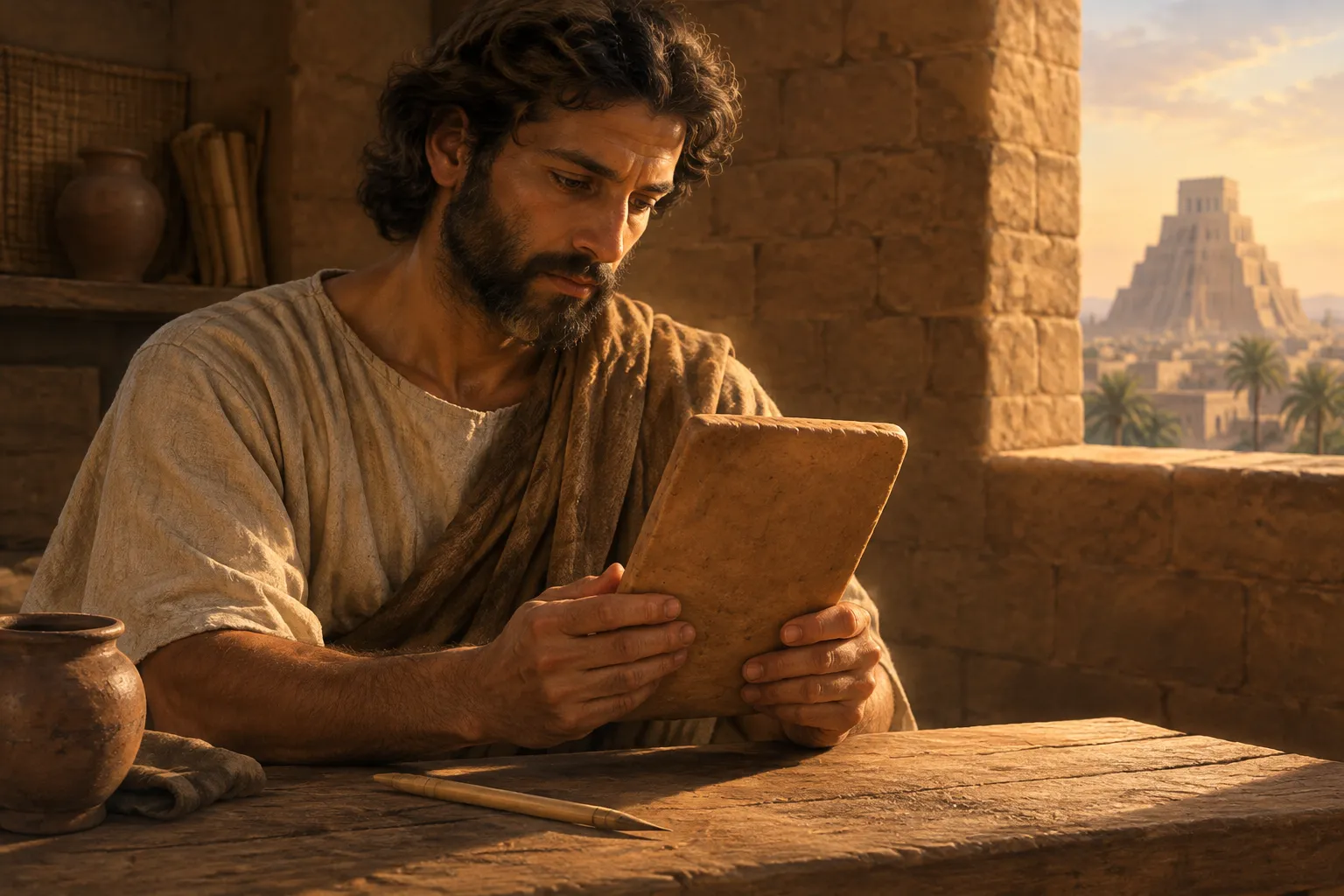
A king asks a god to secure his throne on a writing board. The request makes writing sound less like recordkeeping than a power capable of fixing the future. In the prayer preserved on the Antiochus Cylinder, Nabu’s board belongs to the ordering of heaven and earth. Royal survival becomes something that divine writing can establish.
Why would a ruler approach a writing god for political security? Reading the prayer beside a separately preserved Assyrian dedication reveals the reach of Nabu’s authority. The distinction between the witnesses matters: the cylinder belongs to Babylonian temple culture under Seleucid rule, while the other inscription represents an earlier Assyrian royal setting. They illuminate a shared deity without becoming interchangeable evidence.
1. A Babylonian prayer under Seleucid rule
The cylinder commemorates work at Ezida in Borsippa in 268 BCE. Its ruler, Antiochus I, belonged to the Seleucid dynasty, but the inscription presents his relationship with the sanctuary through Babylonian royal language. It names him as caretaker of Esagila and Ezida and identifies his father Seleucus as Macedonian. These details appear together in the opening royal presentation.
That combination is more revealing than a simple choice between “foreign” and “Babylonian.” The text does not require the king’s ancestry to disappear before he can address a Babylonian god. Instead, it presents temple care as an appropriate royal responsibility. Within this document, the important question is not whether Antiochus was culturally identical to earlier rulers, but whether his kingship could be expressed through obligations that the sanctuary recognized.
This is also why the inscription should not be read as a transparent account of private belief. A royal dedication tells us how authority was presented in a particular religious setting. It cannot, by itself, tell us everything its royal beneficiary thought about the gods.
2. Nabu was not merely a patron of handwriting
The French Ministry of Culture’s specialist glossary identifies Nabu as a Mesopotamian god of scribes, wisdom and writing, and as the son of Marduk, Babylon’s patron deity. It also explains that his temples were often called Ezida, translated there as “the temple of truth.” These associations place writing within a larger divine household and religious order.
Calling Nabu a “writing god” is therefore useful, provided we do not make the label too small. A modern reader might imagine a narrowly occupational patron: someone to help a student form neat signs. Wisdom and divine ancestry point toward a more expansive conception. The writing associated with such a god need not be merely descriptive; in a royal prayer, it can concern how a reign ought to endure.
Divine attributes likewise require context elsewhere in Babylonian religion. The site’s discussion of Gula’s dog as a healing symbol offers another focused example of approaching a deity through an associated symbol rather than assigning that symbol a universal meaning.
3. What does it mean to put a throne on a board?
Antiochus’ prayer connects the security and duration of his rule with Nabu’s cosmic writing board. It ends by including his son Seleucus and his consort Stratonice in its request for favorable destiny. The closing petitions thus extend beyond one man’s lifespan to the royal family.
One way to read this imagery is as a claim about authorization. A throne secured through divine writing is not merely occupied by someone strong enough to hold it today. It has been placed within an order that the prayer asks the god to sustain. This is an interpretation of the imagery, not proof that every Babylonian reader understood divine writing in precisely the same way.
The family dimension sharpens the point. A king’s immediate success and a dynasty’s continued existence are different problems. By bringing relatives into the appeal, the prayer invites us to read royal security as something that must outlast the individual ruler. The writing board supplies an image of durable authority, while the petition itself acknowledges that such durability cannot simply be assumed.
4. An Assyrian dedication tests the narrow label
A separate witness comes from Nineveh. The Walters Art Museum catalogs a limestone inscription as Neo-Assyrian, dated 669–626 BCE, and associates it with Assurbanipal. Its published translation of the dedication to Nabu credits the god with military assistance, describes enlargement of his temple court, and requests long life. This is Assyrian royal evidence, not a second Babylonian version of Antiochus’ prayer.
The comparison is valuable precisely because the settings differ. Nabu could receive a ruler’s thanks for victory as well as petitions involving writing and wisdom. The dedication does not let us reconstruct a complete theology, but it warns against treating modern descriptive labels as exclusive job titles. “God of writing” does not mean “a god whom kings never approached about warfare.”
The museum page also requires care. Its introductory identification names Assurbanipal, while the displayed translation names Ashurnasirpal. That internal inconsistency should not be silently harmonized. The object’s acquisition history likewise records Nineveh as a claimed origin rather than documenting a controlled excavation. These limitations qualify how confidently we use the witness; they do not justify inventing a solution.
5. Read the request, not just the divine title
The most useful question is therefore not simply “What was Nabu god of?” It is “What is this speaker asking Nabu to do?” Antiochus’ prayer makes divine writing a way to imagine secure kingship. The Assyrian dedication makes divine assistance part of the explanation for royal victory. Neither text needs to exhaust the god’s identity.
Both are interested documents. A request for long life is not evidence that long life followed; a claim of divine military support is not independent confirmation of that support. Read as royal religious statements, however, they reveal how a ruler could place achievement and vulnerability in the same address to a god.
That is the payoff of the writing board. It makes an apparently specialized divine attribute politically consequential. In the Babylonian prayer, the king does not merely want his name remembered. He asks for his future to be made secure.
Sources and further reading
- Antiochus Cylinder: Akkadian text in translation, with commentary and bibliography.
- Nabu: French Ministry of Culture glossary entry on the deity’s principal associations.
- Tablet with Cuneiform Writing, accession 41.163: museum description, translated inscription and provenance information.


