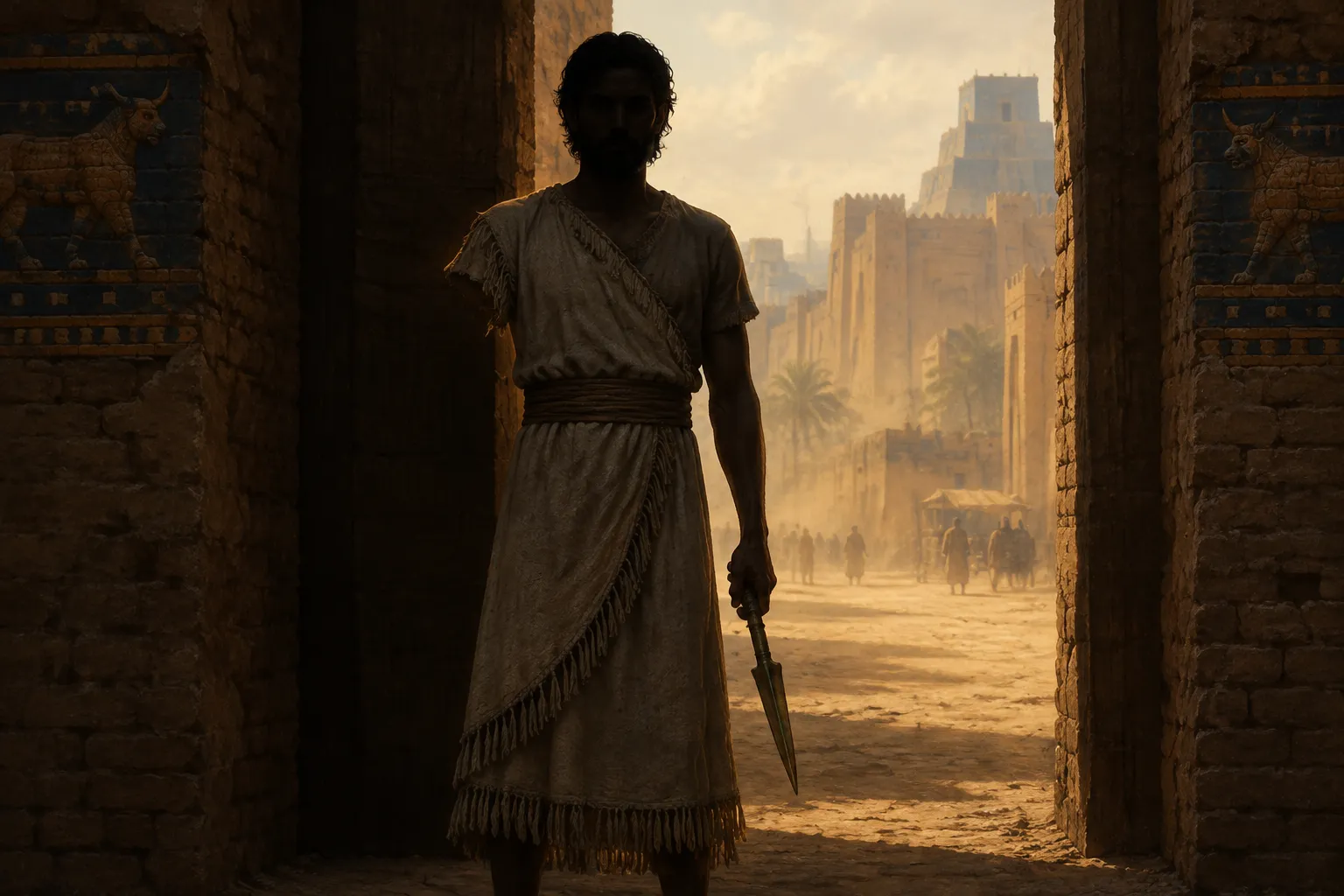
The dangerous figure entering Babylon does not necessarily look like a monster. He may look like a man carrying weapons. In the Babylonian poem Erra and Ishum, the god Ishum confronts Erra, a deity of war and disease, with an extraordinary accusation: he has changed his divinity and become like a human being. But what kind of change does that mean?
The question turns on a single line, Tablet IV, line 3. Was Erra behaving like a mortal, or had he actually taken human form? Eli Tadmor’s study of the passage distinguishes these readings and argues for the second. The difference matters: it changes how we imagine the god’s presence in Babylon, and how we understand the poem’s unsettling overlap between supernatural destruction and human violence.
A Babylonian poem, not a timeless legend
Erra and Ishum is an Akkadian-language Babylonian composition of the first millennium BCE. Its literary setting is Babylonia, and its central divine figures include Erra, his counsellor Ishum, and Marduk. Andrew George’s study of the poem as a response to war emphasizes the destruction inflicted on society rather than treating the narrative simply as a succession of divine adventures.
The poem also names a human compiler, Kabti-ilani-Marduk. The biographical entry in World Eras places him around the eighth century BCE and explains the concluding claim: the poem came to him in a dream, and he transmitted it without alteration. That is the work’s account of its own authority, not something a modern reader can independently verify.
These distinctions are worth keeping separate. A proposed date for a poet is not automatically the date of every event behind his story. A divine revelation claimed within a work is not an eyewitness report. And a Babylonian poem written in Akkadian should not be relabelled a Sumerian myth merely because it belongs to the wider literary world of ancient Mesopotamia.
The accusation: behaving humanly or becoming human?
Tadmor renders Ishum’s statement as “you changed your divinity and seemed like a man.” His discussion of the two interpretations identifies the essential disagreement. In one reading, Erra resembles humans in his conduct. In the other, he resembles them physically.
The first interpretation makes the line a judgment about behaviour. Its force would lie in the contrast between a god’s identity and the mortal-like way he acts. The second makes it a statement about manifestation: Erra has assumed a form in which a person might encounter him as a human being. These are not merely two picturesque ways of describing the same scene.
Consider the difference as a reading exercise. If someone says a ruler has become a beast, the statement might condemn his cruelty without asserting that his body has changed. But in a story where transformations are possible, the same kind of language might describe an actual change of appearance. That analogy does not settle the Akkadian; it explains why translating the sentence cannot be separated from interpreting it.
Tadmor argues that the physical reading better explains this passage. His argument draws on the meanings and uses of the Akkadian word ilūtu, usually translated as divinity, as well as passages in Ludlul bēl nēmeqi and Enūma eliš. He also considers a metaphor elsewhere in Tablet IV concerning Erra’s slaughter of Babylon’s inhabitants. His conclusion is specific: Ishum is describing an assumption of human form, not simply human-like behaviour. It remains an argued interpretation, not a newly discovered sentence that removes every ambiguity.
A god’s violence on a city’s streets
The surrounding narrative makes the question more than an exercise in vocabulary. In the Tablet IV passages translated by George, Erra enters the city armed, Babylonians gather around him, soldiers take up weapons, and the city’s governor orders destructive action. Divine violence is narrated through recognizable human agents.
On a physical reading, the frightening possibility is proximity. The god of violence need not remain somewhere beyond the city, sending disaster from a distance. He can enter the human scene. On a behavioural reading, the emphasis falls differently: divine action is being described through the disturbing likeness between gods and mortals. Either way, the passage resists a comfortable separation between a supernatural catastrophe and the people who enact it.
This is an interpretation of the scene, not evidence that every Babylonian understood every conflict as a disguised god’s intervention. Nor does the passage allow us to identify a particular ancient person simply from the presence of weapons or a crowd. The poem gives readers a problem of agency; it does not supply a modern historical investigation.
Was the human figure a usurper king?
Tadmor takes the physical interpretation a further step. He tentatively proposes a connection with a usurper who rose against the Babylonian king Adad-apla-iddina. Under that hypothesis, Erra’s human manifestation would be a violent claimant to royal power.
The qualification is essential. Tadmor explicitly describes this proposal as tentative and speculative. It should not become a confident retelling in which Erra certainly transforms into a named historical rebel. The accessible article abstract supports reporting the hypothesis and its uncertainty, not presenting a complete reconstruction of the rebellion.
There are therefore two separate questions. First, does the Akkadian line describe physical human likeness? Second, if it does, does that human form point to a particular political figure? An argument for the first does not by itself prove the second. Readers can find the physical interpretation persuasive while remaining unconvinced by a specific historical identification.
Keeping those steps apart preserves what makes the proposal interesting. It suggests a possible bridge between mythic language and Babylonian political experience without pretending that the bridge has been securely mapped.
Why the ambiguity is worth preserving
The best payoff is not a definitive portrait of Erra’s human face. It is a sharper way of reading the poem. Ask what Ishum’s accusation makes visible: a god acting like a mortal, a god appearing as one, or a literary connection between divine devastation and the exercise of human power. Tadmor’s interpretation makes the second possibility especially compelling, while its historical extension remains provisional.
For a different aspect of the site’s treatment of illness and divine intervention, see Gula’s Dog: How a Babylonian Healing Symbol Worked. The connection is thematic rather than narrative: healing and destructive divine power offer different starting points for thinking about vulnerability.
Erra’s disputed transformation rewards precisely this kind of careful reading. We do not have to turn uncertainty into certainty to find the scene disturbing. An armed figure enters Babylon, and the poem asks its readers to recognize something more than a man.
Sources and further reading
- Eli Tadmor, “Erra’s Human Form”, KASKAL (2025). The publisher’s HTML abstract outlines the linguistic argument and explicitly qualifies the historical proposal. Open-access scholarship licensed CC BY.
- A. R. George, “The Poem of Erra and Ishum: A Babylonian Poet’s View of War”, in Warfare and Poetry in the Middle East (2013), pp. 39–71. Author-uploaded full text readable in HTML.
- World Eras, “Kabti-ilani-marduk”. A concise reference entry on the named compiler and the poem’s claim of dream revelation.