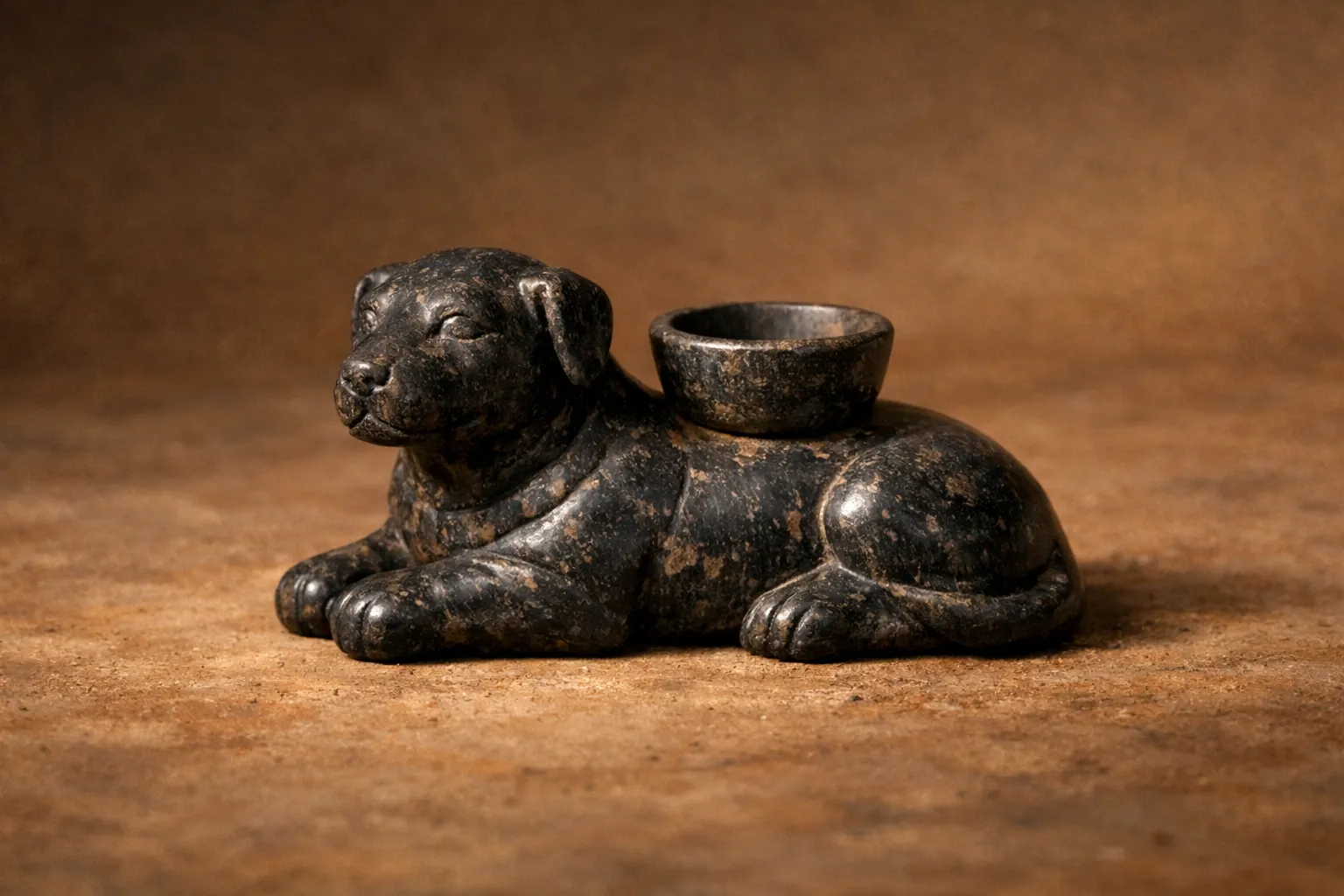
A small dog can carry a large religious meaning. In the British Museum’s account of a Late Babylonian terracotta animal, inscriptions identify the dog as the emblem of Gula, goddess of healing. Yet the same account distinguishes that emblem from protective dog figures that belonged to no particular deity. The animal alone does not tell the whole story: context changes what a dog means.
That distinction opens a more interesting question than whether Babylonians considered dogs sacred. How could the same animal represent a healer, carry a dedication for someone’s life, and protect a building? A handful of documented objects lets us separate those functions without inventing a lost myth explaining them all.
1. An emblem, not an animal biography
The British Museum’s fired-clay dog, registration number 1854,0401.32, stands 14.4 centimetres high. Its catalogue dates it broadly to 700–500 BCE and labels its culture Late Babylonian. The museum suggests it formed part of a larger statue or temple ornament; that reconstruction is a possibility, not an established original setting.
The accompanying explanation traces the seated dog as a divine symbol from the Old Babylonian period into the Neo-Babylonian period. It also reports that Nebuchadnezzar II, who ruled in 604–562 BCE, recorded offerings of dogs made from gold, silver, and bronze at the gates of Gula’s Babylon temple. Here the connection is specifically Babylonian, rather than an undifferentiated claim about all Mesopotamia.
An emblem provides identification, not necessarily a narrative. We should not turn a dog beside a goddess into evidence for an otherwise unattested adventure, divine pet’s name, or story of animal transformation. The stronger question is what the image allowed a viewer to recognize.
2. A physician’s dog—and a different goddess’s name
An earlier object offers unusually concrete evidence. The Louvre’s Chien de Sumuel, AO 4349, is a reclining steatite dog with a small removable vessel on its back. Only seven centimetres high and 11.5 centimetres long, it belongs to the reign of Sumu-El of Larsa, dated by the museum to 1894–1866 BCE.
Its inscription matters more than any resemblance to later images. The Louvre identifies the text as a Sumerian dedication by a physician of Lagash to the goddess Ninisina, for the king’s life. The archaeological findspot was Tello. These details supply a named profession, recipient, beneficiary, language, and location—not merely a modern impression that the dog looks religious.
Calling this simply “Gula’s dog” would erase the name actually attached to the dedication. Johanna Stuckey’s survey of Mesopotamian healing goddesses treats Ninisina, Gula, Bau, and Ninkarrak within a broader healing tradition. For this object, however, the precise label remains Ninisina.
The distinction also prevents language from becoming a misleading cultural shortcut. A Sumerian inscription on an object dated to the Old Babylonian period does not make “Sumerian” and “Babylonian” interchangeable descriptions. They answer different questions about the evidence.
3. Why a healer’s dog appears on legal monuments
Healing was not the only setting in which Gula’s emblem mattered. The University of Mainz’s explanation of kudurru monuments describes stone records of legal acts, especially royal grants of land. These monuments begin appearing in the Kassite period, approximately 1500–1155 BCE, and seem to have been placed in temples under divine protection.
Their imagery gathers recognizable signs of different gods. Mainz identifies Gula through the dog, Marduk through the spade, and Ishkhara through the scorpion. The inscriptions describe transactions, record witnesses, and threaten anyone who destroys the agreement or monument with curses.
In this setting, the dog need not illustrate medical treatment at all. Its role is to make Gula present within the monument’s divine company. That is the interpretive payoff: a healing goddess’s emblem can function in a legal setting without ceasing to identify her.
Nor should every animal carved nearby be read as part of one story. A grouping of divine signs is not automatically a scene of interaction. Before supplying a plot, we need to establish whether the images identify powers, depict an event, or perform some other function.
4. Did Gula’s temples work like hospitals?
The temptation is understandable: a healing goddess, sacred dogs, and requests for recovery seem to add up to a temple hospital. But Troels Pank Arbøll’s study of sanctuaries in medical prescriptions stresses how uncertain that reconstruction remains. Medical tablets rarely mention temples, and the ordinary setting for healing ceremonies was the patient’s house.
There is nevertheless evidence for petitioning Gula at her sanctuaries, personally or through someone acting for a sufferer. Dogs were kept at several of her temples, while figurines from Isin may reflect acts of supplication. Those observations support a connection with recovery, not a complete account of institutional treatment.
Arbøll also cautions that a word translated as sanctuary could designate a temple, local chapel, or domestic place of worship. Some prescriptions may concern obtaining favourable circumstances for treatment rather than receiving treatment inside a major temple.
The difference is substantial. A place where people seek divine help need not be a ward; an offering need not be medical equipment. Keeping those possibilities separate makes the surviving evidence more informative, not less evocative.
5. Why dogs? Where the evidence stops
Stuckey’s discussion of the dog association explicitly leaves its origin unresolved. Wound-licking is offered as one possible explanation, not as a demonstrated ancient doctrine. Her survey also reports dog images and votive objects from Isin, including a figure embracing a dog and clay dogs, one bearing a prayer.
Such objects show the association being expressed. They do not, by themselves, tell us how it began. Explaining an emblem through an animal’s observed behaviour may sound persuasive, but plausibility is not the same thing as an ancient explanation preserved in a text.
This is also a useful reading test for our discussion of tortoise symbolism in Babylonian beliefs: ask which named object or text supports each proposed meaning. That related article should not itself substitute for ancient evidence.
Gula’s dog rewards that discipline. A dedication names its recipient; a legal monument places a deity among divine guarantors; a protective figure may serve another purpose altogether. Rather than reducing every dog to one timeless meaning, we can ask what this particular dog was made to do.
Sources and further reading
- British Museum: Terracotta figure of an animal, presented through Google Arts & Culture.
- Musée du Louvre: Chien de Sumuel, object AO 4349 and its Sumerian dedication.
- University of Mainz: Kudurru, on legal monuments and divine emblems.
- Troels Pank Arbøll: Patients Seeking Out Sanctuaries of Deities in Medical Prescriptions, published in IRAQ.
- Johanna Stuckey: “Going to the Dogs”: Healing Goddesses of Mesopotamia, a bibliographically referenced overview.


